

Election update: Have you requested your ballot for Chicago’s Nov. 3 school board elections? Join more than 3,000 Chicagoans who have requested their ballot here. And check which candidates are running in your school board district here.
Big cities need lawyers.
For more than a century, Chicago’s top lawyer has been chosen by the mayor and has served at the mayor’s pleasure.
But is that structure serving Chicagoans well?
With last week’s resignation of Chicago’s corporation counsel, it’s a timely question. And a new report from my colleague at the Chicago Policy Center arguing for an elected city attorney shows why it’s worth asking.
How did Chicago lose its elected city attorney?
Today, Chicago’s top lawyer is called the corporation counsel.1 The mayor picks this person, the City Council confirms them, and the mayor can fire them at will.
The corporation counsel runs the city’s Law Department, which houses about 270 attorneys who represent the city in lawsuits, negotiate settlements, and advise the mayor, the City Council and city departments.
But for more than half a century, Chicago also had an elected city attorney. This office handled lawsuits against the city, hired its own staff and reported to the City Council every year on every case the office was handling.2
That all changed in 1905.
The Illinois General Assembly passed a law asking Chicago voters to approve an amendment to the state’s Cities and Villages Act. This amendment abolished Chicago’s elected city attorney and handed its duties to the corporation counsel’s office, alongside several major changes to city government, including (among others):
Extending the mayor’s term from two years to four.
Giving the mayor power to release anyone jailed for violating a city ordinance.
Making interest earned on city funds belong to the city, not to the treasurer or other officers holding the money.3
Barring Chicago aldermen from holding other federal, state or city civil offices.
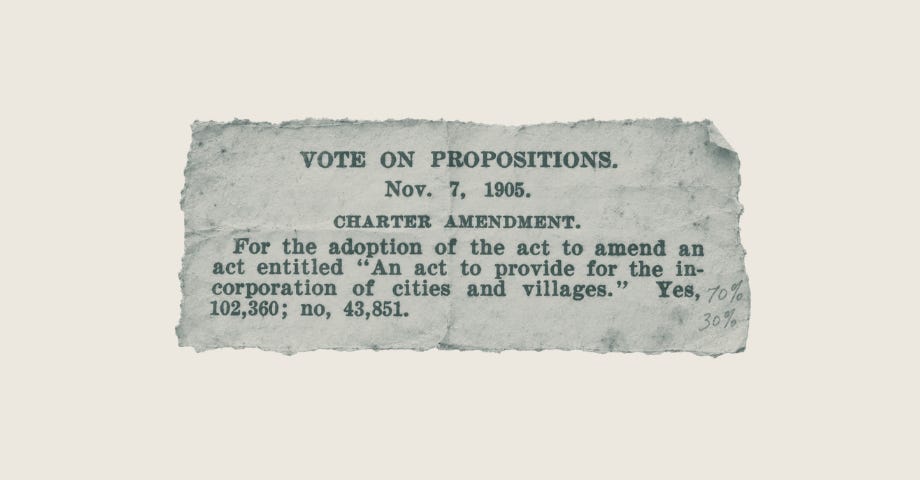
Voters approved the question: 102,360 yes (70%) to 43,851 no (30%)

But there were two major problems with this vote.
First, the electorate was entirely male. Women did not win the right to vote in Chicago city elections until 1913.
Second, voters saw essentially no information about what they were voting on. The ballot question was both oddly worded and extremely vague:
For the Adoption of the Act to Amend an Act Entitled, "An Act to Provide for the Incorporation of Cities and Villages." Yes ▢ No ▢
The Chicago Eagle newspaper described the gambit this way:4
The extending of the mayor’s term from two to four years was accomplished at the polls on Tuesday.
But it was accomplished by the most barefaced trickery ever attempted at a Chicago election.
Outside of some of the editors of some of the daily papers, and some deep-dyed villain as yet under cover, no one in Chicago was in favor of this outrageous scheme.
The official ballot bore no reference to it.
The nefarious plan was hidden under a statement on the “little ballot” that purported to “amend an act relating to cities and villages.”
Many people believed that this was the new charter talked of so much by our reform newspaper tom-cats.
They dared not submit the proposition clearly to the people.
So in short, Chicago’s politically powerful succeeded in abolishing the elected city attorney’s office.
But they did so by ignoring women and tricking men.5
Controversies in the corporation counsel’s office
Worries that a mayor-appointed corporation counsel will put the mayor’s interests ahead of the city’s aren’t new. They go back more than a century.
A 1903 story in the Chicago Tribune, “His Own Work Condemned by Corporation Counsel,” shows the problem.
At the time, the corporation counsel’s office drafted ordinances for aldermen. The Council would often pass those ordinances unchanged, but then the corporation counsel would advise the mayor to veto them as “not properly drawn.”
The explanation from an assistant corporation counsel was that ordinances drafted for the Council were “unofficial.” But when the mayor asked for an opinion, “our action is official.”
There has been no shortage of controversies since.
My colleague Gerrin Alexander’s new report for the Chicago Policy Center details several recent examples:
The Anjanette Young raid: In 2020, the Law Department, then run by a longtime friend of Mayor Lori Lightfoot, tried to block a TV station from airing body-camera video of police handcuffing an innocent, naked woman during a wrong-house raid, and sought sanctions against her attorney. The corporation counsel resigned amid the uproar.
ShotSpotter: When the City Council twice voted to rein in Mayor Brandon Johnson’s cancellation of the gunshot-detection contract, the Law Department sided with the mayor, arguing the Council’s ordinance violated the separation of powers. That left aldermen in a bind. Under state law, the corporation counsel is “the legal adviser of the city council.” Aldermen threatened to sue, but repeated efforts to give the Council independent counsel have stalled.
The “gift room” scandal: In 2025, then-Inspector General Deborah Witzburg told aldermen the Law Department “selectively acts in opposition” to her investigations when they could embarrass city leaders, including her probe of the mayor’s gift room.
And it’s not just a Chicago problem. In 2024, New York City’s top lawyer was pushed out after raising concerns about her department defending then-Mayor Eric Adams in a sexual misconduct lawsuit.
What an elected city attorney could do for Chicago
Before 1905, Chicago’s elected city attorney defended the city against lawsuits from people injured on its broken streets and sidewalks.
Today, the lawsuits look different. In 2025, Chicago taxpayers spent nearly $259 million resolving police misconduct lawsuits, more than five times the Law Department's entire budget. The city also paid a record $36 million to private lawyers to defend those cases.
The mayor runs the Police Department. The mayor also hires, and can fire, the lawyer who defends it in court. That lawyer negotiates the settlements that aldermen are asked to approve.
An elected city attorney would answer to voters instead. That lawyer would be freer to say plainly when the same kinds of cases keep costing taxpayers, and to push for changes that would stop them.
An elected city attorney could also:
Take a harder look at bad deals: An appointed lawyer has little incentive to challenge contracts signed by the boss. An elected one could independently investigate deals such as the 75-year parking meter lease. In San Diego, the elected city attorney helped void the city’s lease deal for an office building after uncovering a broker’s conflict of interest.
Referee fights inside City Hall and give aldermen straight answers: When the mayor and Council disagree, the city’s lawyer shouldn’t work for one side. An elected city attorney wouldn’t have to worry about how the mayor might react to a legal opinion before giving it to the City Council.
Stop running interference for the mayor: An independent lawyer would have less reason to slow-walk inspector general investigations that could embarrass the administration.
Electing a government’s top lawyer isn’t unusual. In 43 of 50 states, including Illinois, voters elect the attorney general. Los Angeles, San Diego, Columbus, Ohio, and Milwaukee elect their city attorneys.
The elected city attorneys in those cities say independence is the point.
“They’re not my boss,” Columbus City Attorney Zach Klein told the Chicago Policy Center of his city’s mayor and council. “The voters are my boss, but [the mayor and the council] are my client.”
Former Los Angeles City Attorney Mike Feuer said being elected frees the office to give honest advice: “One isn’t concerned that the advice one gives might lead to losing one’s job.”
The problem with Chicago’s corporation counsel isn’t about any one person. It’s structural. A lawyer the mayor can fire will always face pressure to protect the mayor.
How Chicago can create an elected city attorney’s office
On Feb. 23, 2027, Chicago voters will weigh in on a nonbinding question asking whether the City Council should have its own independent legal counsel.
When aldermen put that question on the ballot, Mayor Brandon Johnson argued the Council couldn’t create its own counsel without permission from the state. State law does name the corporation counsel as the City Council’s legal adviser. That’s exactly why the structure needs to change.
The correct answer to that nonbinding ballot question is yes. But voters deserve a binding vote on the office itself.
The Illinois Constitution lets home-rule cities such as Chicago change how their officers are chosen, but only with voter approval. There are two ways to get the question on the ballot:
The City Council puts it there. Aldermen can pass an ordinance placing a binding referendum before voters.
Chicagoans put it there themselves. Residents can gather petition signatures to force the question onto the ballot.
If voters say yes, Chicago would elect its city attorney alongside the mayor, clerk and treasurer, in nonpartisan elections with a runoff if no candidate wins a majority.
In 1905, Chicagoans gave up their elected city attorney on a ballot that didn’t say so.
This time, the question should be clear.
In the news
Using schools for politics: Thank you to Chicago Public Schools board member Michilla Blaise for taking down a political advertisement filmed inside a CPS school, which spurred an ethics complaint from the Chicago Policy Center. We’ll continue to monitor use of CPS property and resources for political purposes as early voting begins this week for Chicago’s historic school board races. Case in point: we filed another ethics complaint last week regarding Board Member Aaron “Jitu” Brown’s apparent use of CPS resources for political activity.
Mincing Rascals: I joined John Williams, Eric Zorn and Marj Halperin on this week’s Mincing Rascals podcast to talk about President Donald Trump banning CNN, MS NOW and Politico from the White House, mayoral candidate Bill Quinlan’s lawsuit against several mayoral candidates running for other offices, and Chicago’s school board elections (Spotify, Apple Podcasts). My “green light” recommendation: the Music Box Theater’s screening of Babylon (1980) on Sept. 27 and Sept. 29.
Public school advocates back opting in to federal tax credit: Stand for Children Illinois, which self-describes as “anti-private school voucher,” is urging Gov. JB Pritzker to opt Illinois in to the federal tax credit scholarship program, with a new policy brief on how the scholarships can fund tutoring, after-school programs and career training for public school students. I’ve written about why opting in would benefit Chicago public school students, specifically.
Why “corporation”? Legally, the city of Chicago is a municipal corporation.
Here’s a brief timeline of how the two offices came to be:
When Chicago incorporated in 1837, the City Council appointed a city attorney.
In 1847, the Illinois General Assembly made Chicago’s city attorney an elected office.
By 1863, Chicago also had a mayor-appointed “counsel to the corporation” who ran the Law Department.
Yes, Chicago city treasurers traditionally pocketed the interest on city deposits. Treasurer Peter Kiołbassa earned the nickname “Honest Pete” in the 1890s in part for returning interest back to the city.
“Tom-cats” is the Eagle mocking reform newspapers that were advocating for Chicago to adopt a new, comprehensive city charter, suggesting voters approved this measure thinking it was that reform. Also note the Eagle paraphrases the ballot language.
Five Chicago voters sued after the 1905 election, arguing state law required ballots to “clearly indicate” the substance of any measure. The Illinois Supreme Court disagreed, ruling the legislature could write its own ballot language for Chicago-only laws (Swigart v. City of Chicago).
I disagree. We already have too many elected positions which makes it hard to drive in the same direction. Plus you see in states all over that elected attorney generals pursue quixotic political quests.
The problem you outlined is real. But the solution was identified 100 years ago when cities under the progressive movement eliminated mayors in favor of council -manager systems. We should abolish the mayor and have a non-political executive running the day to day affairs of the city. This would massively improve functioning and remove opportunities for shenanigans